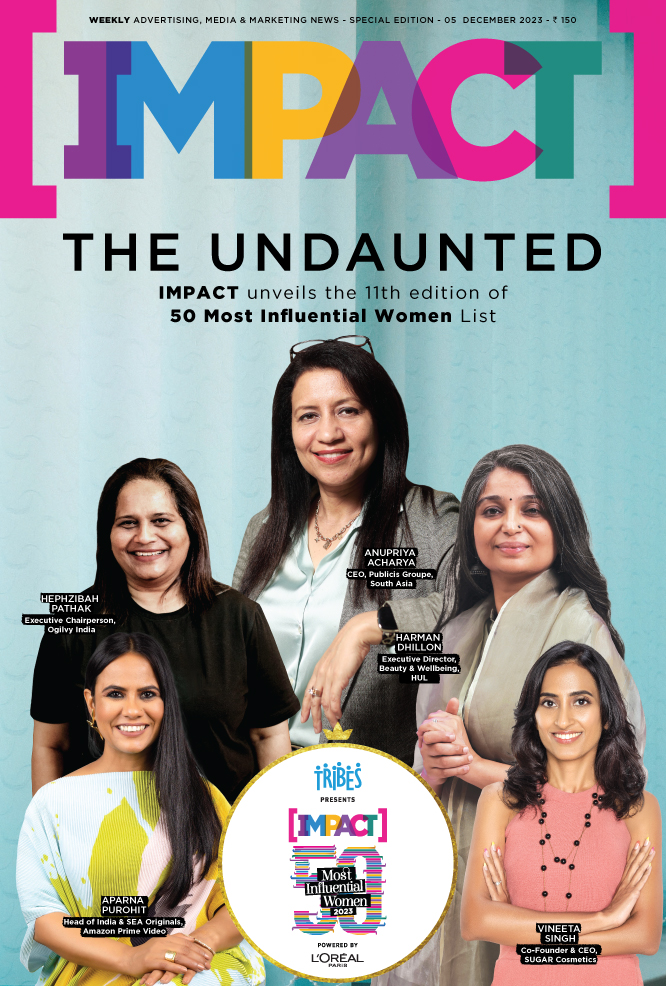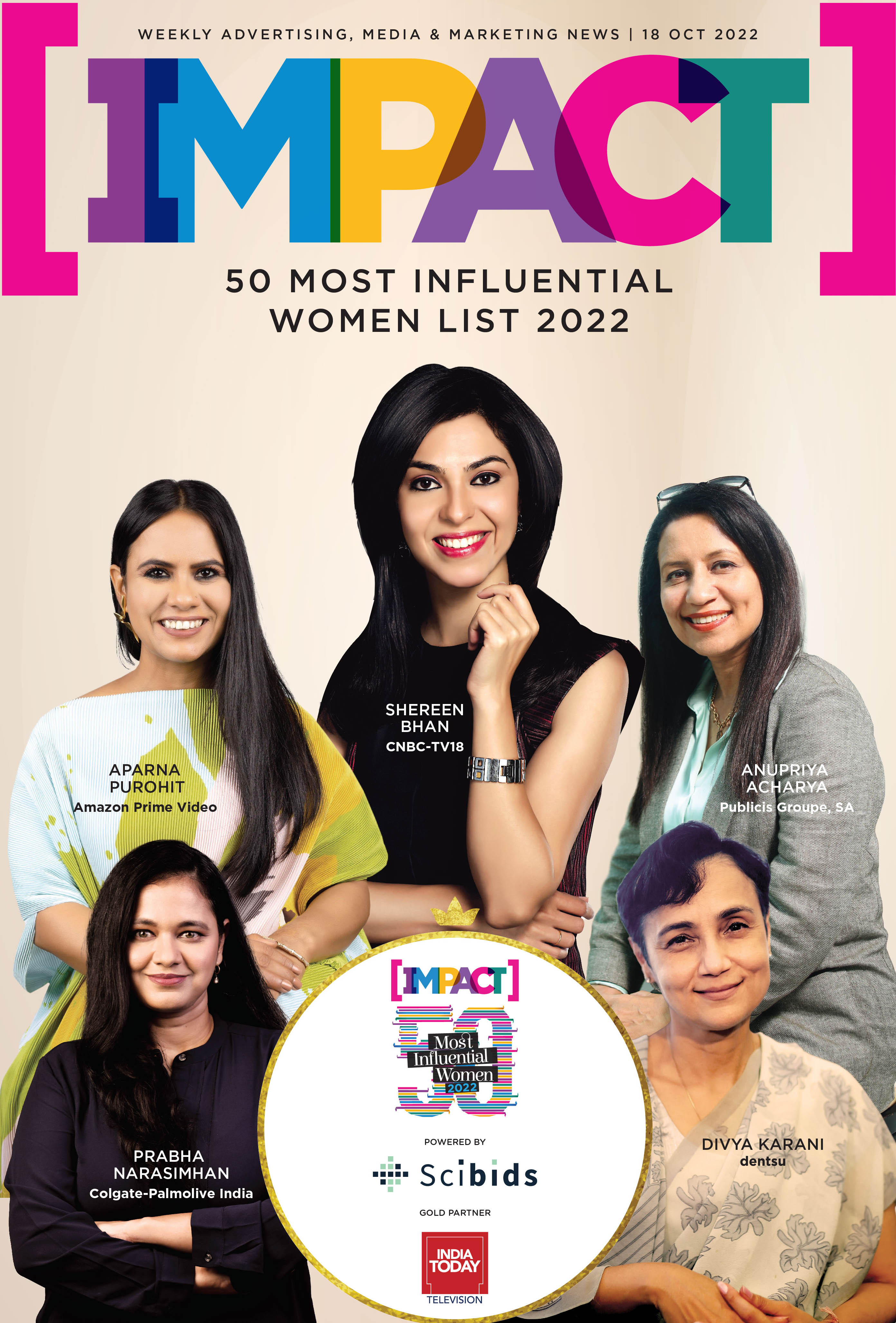


If you are walking outside the Palais Des Festivals at Cannes Lions, it is likely that you would find Anupriya Acharya walking with an umbrella, earnestly attempting to shield herself from the harsh sun along the French Riviera. Her role on the ground as the CEO of the Publicis Groupe, South Asia has been no different. For the past six years, she has made sure that the holding company is well protected from the turbulence the ad industry has been facing.
In Q1 this year, the global Publicis engine hummed beautifully at a steady 6.4 per cent organic growth. But India put its foot on the accelerator, emerging as one of the fastest growing markets for the Group with a massive 11.7 per cent leap during the same period. In comparison, WPP, the number 1 player in India, registered a 1 per cent growth. In South Asia, the agency has a battle-tested leadership team, from Rajdeepak Das on the creative side, to Lalatendu Das on the media side and several others, who report to Anupriya Acharya.
In an in-depth chat with Neeta Nair, Editor of IMPACT, Anupriya talks about what Publicis understood of the market in India which their competitors perhaps underestimated. She says, “For the longest time, India has been talked about as a growing market. While this is not new, what people could have missed in marketing is how fundamentally charged the operating model is today. Today, digital-first and mobile-first markets have become a part of the operating system. We are one of the biggest nations with 1.4 billion population and 900 million Internet users, which means technology is being adopted very fast and people are connected. It is now a multi-screen market with endless choices and while traditional assets like TV are present, there is substantial growth in CTV, OTT, YouTube, Instagram and so on. So, now when you are talking to the consumer, you must be interesting and capable of gaining attention.”
Elaborating on what is dominating the market today, she says, “It is not about buying reach but about buying relevance. Nearly 25 per cent of global YouTube content is created in India. It’s a video-first market. So, for brands, everything must be video-first and short form-first. It is a regional-first market, with even Hindi not being so dominant. Today, some regional languages have higher collective reach compared to Hindi, so you must think of multilingual campaigns. Additionally, influencers are shaping how brands are purchased today and alternatively in the world of AI, people are just dictating what they want, without wanting to go through several websites. They want ready-made answers.”
Giving an insight on creating assets related to modern marketing, Anupriya emphasises that Publicis did a good job of understanding the operating system by investing $12 billion over the last decade on tools, data and building an AI foundation which all verticals can leverage equally, and by adapting to the changing systems faster than anyone else in the market.
Not surprisingly, as per a recent report by Mediasense, Publicis Groupe garnered 56 per cent of all worldwide billings in global new business in 2025. The Group has seen a turnaround towards the end of 2010s after its investment in Epsilon, Sapient and Marcel paid off and has been fighting tooth and nail for the number 1 holding company spot in the global market and in India. The recent wins in India namely Flipkart, Loreal, the extended Pepsi and Nestle mandate, Kenvue etc are proof of that along with 98 per cent client retention rate.
Besides her role at the agency, Anupriya has added another feather to her hat, as the Jury President at Cannes Lions for Creative Data this year. She has also had a front row seat to the industry’s evolution as a two-time President of AAAI. Anupriya says that while agencies, both network and independent, need a lot of enterprise level investment in technology, they must be mindful of the AI slop in the market that nobody is watching.
It was clearly a case of baptism by fire, the ultimate test of resilient leadership for the first woman CEO of a holding company in India. Even before the victory lap ended for her in December 2019, she was forced to deliver a masterclass on crisis management with Covid steering the industry into an unprecedented tailspin. Interestingly, Publicis Groupe South Asia sailed through the storms of economic disruptions, to register a double-digit growth for five consecutive years in South Asia, that followed, under her leadership. In an in-depth interview, Anupriya Acharya, CEO, Publicis South Asia, tells Neeta Nair, Editor of IMPACT how they cranked up the volume and pushed the growth agenda for the Group in half a decade.
Q] Among the top three advertising holding companies in India (WPP, Publicis and Omnicom), Publicis Groupe is the only one to have a holding company CEO role, a position that even WPP retired after CVL Srinivas’ departure. What according to you is the relevance of this position today in the Publicis model?
It has been almost a decade since we moved into such a structure because we were convinced that in the future of modern marketing, there is no place for silos. Connected solutions are increasingly important. The move to this integrated structure happened in early 2018-20, and I took over the group role in 2019. Today, more companies are embracing this structure; I am glad we have been here for a longer period.
Q] Harsha Razdan has spoken about Dentsu’s shift towards a consulting-led model in India. As someone leading technology, creative, data and media under one roof at Publicis, do you believe the traditional agency model is becoming obsolete?
What you are saying is true in a way, but I can’t claim that the agency model is dead. Integration doesn’t mean diluting everything a network has and bringing it together under one roof, that’s a misunderstanding. We forget that there is still the need for specialist solutions and excellence in each of these verticals. Then comes the point of bringing it together seamlessly. That is where we talk about data, AI layer and intelligent solutions, all of which requires trained talent to implement. The final test is in these questions—is the consumer experiencing it as a connected capability or communication and is it eventually giving growth to the brands and the clients.
Q] You often speak about the ‘Power of One’ as a key competitive advantage. While it addresses the challenge of agencies operating in silos, clients themselves are often structured in silos with pitches called separately across creative, digital and media functions. In such a scenario, how do you bring together your integrated capabilities to deliver a unified solution?
What sets us apart is the high number of investments we have made in our individual capabilities. We stand out when it comes to creativity, media, commerce, performance etc. Nowadays, clients are calling for pitches for many specialist capabilities like commerce. It doesn’t matter for which vertical the client contacts us for because we believe we need to ace everything; and the growth for the brand does not lie in any one line of business. Usually, the client bit by bit realizes that it will work out to be better if we layer other solutions to the scope of work entrusted to us. A lot of our growth has happened by expanding the mandates we have with our existing clients.
Q] Recently, while interviewing Marco Venturelli, global CEO of creative agency—Leo, he told me how he was proud of their team in India for cracking the ‘Ghoomega Paiyya’ idea for Shriram Finance. Days later Omnicom’s media agency, PHD claimed it was their baby. Doesn’t lack of integration across media and creative affect ownership. Also, who takes credit if the idea was worked on by two different networks?
In this case, Leo worked with a different network because for us the most important aspect is the client’s growth. The client may have chosen us for only a part of the business, but we give them the best capabilities, which is not just accoladed, but also moves numbers for clients. In any case, it is not like awards are a byproduct of everything that we do.
Q] When Coca-Cola came to WPP, PepsiCo left the wing. PepsiCo then parked its business with the Publicis Groupe globally. And now, Coca-Cola has again called for a global pitch which Publicis is participating in. Will we see a major realignment of agencies yet again?
Firstly, I’m not aware that there is a pitch on Coca-Cola. I read the same news report as you. I understand they’re looking at capability reviews. PepsiCo has given us their entire business and we value that immensely. But you must also know that we work with Coke in North America. At our end, we assess our partners all the time. Clients also need to do that. Even PepsiCo has globally assessed a lot of our capabilities on several occasions. I believe that’s business as usual.
 Q] Is the focus then on winning global mandates and being the agency of record across board? Or, is it about having a part of the prestigious business in different geographies of the world, along with their competitor’s account in other places and thereby having a diverse client base?
Both work well. 70 per cent of our business here is pitched and won in India, and many of our global clients are with us here because we suited their requirement. The contribution of global business is only 30 per cent. I’ll give you an example. Diageo, for example, is globally aligned with various shops including us. But they got intrigued with the Publicis model which led to more discussions till they decided to park a large part of their business with us. They felt that we can provide them end-to-end services with the best of craft. See, every client is not in the same position everywhere in all the markets, they have different requirements and may operate differently in Asia vs. Middle East, may or may not be the dominant brand in specific markets. The choice of an agency depends on all these factors.
Q] What do the clients want today? With agency margins shrinking, what will make the client want to pay the agency more?
Fundamentally, I do believe that if an agency can find ways to give more value at a good price, especially in this day of tech and AI, then there is nothing wrong with it. But remember your investment in AI, data and training talent, you need to keep that in mind to charge the right price for the service. Clients value the solutions that are not available elsewhere. We have had cases, where a solution comes up top of the chart in a pitch or meeting but at that point in time, the client may choose to say, ‘no, this doesn’t really fit my budget’. As much as we want to make it work, if it is impossible, then both parties must understand. Then there are clients who say we are getting this cheaper outside, and we go on to defend our solution and yet they leave. But we’ve also oft seen that clients come back to us after a few years.
Q] The industry’s biggest holding groups are restructuring around AI, data, and consulting capabilities. Publicis too has capabilities such as PDX, Connected ID, Influential and Intelligent Content. Do you see the future CEO of an agency network looking more like a technologist than a traditional advertising leader?
I don’t think it will be somebody from a technology background just as it won’t be from a traditional agency background. The future is, of course, highly tech and AI and some bit of fluency in technology, data and AI is very important. Like I’m learning all the time, it’s part of our DNA. But on the other side, you need classic creativity and the ability to motivate people. In the years to come, your ability to read the future, emerging trends, and create a vision and a roadmap that is sharply articulated for all your people will be pivotal.
 Q] Talking about mergers and consolidation, the recent one involving Publicis WW wasn’t about cost-cutting, you didn’t lay off employees. And yet on the other side, the fast adoption of agentic AI in business might necessitate downsizing considering that the same task now can be handled by fewer people. How will you save your talent then?
That’s a great question. See, AI must be looked at via different filters and not necessarily from the one where it snatches jobs. So far, we are not seeing that. Firstly, we are a growing organisation in a growing market. We need more people, despite all the AI simplification or AI productivity that we are bringing in. Everyone uses ChatGPT but that’s not the same as creating AI impact, for that you need enterprise level solutions that can work seamlessly because businesses will be re-engineered keeping agentic in mind. AI manages a lot of work on its own, but you need people who are trained in it and we are investing heavily in acquiring and training that talent. Meanwhile because of AI everyone is managing their mails, calendars better, unlocking time which was utilised in mundane tasks. It is adding value to humans in certain areas—generating assets in a shorter time, perhaps creating effects which were not possible before AI.
Q] Talking about Publicis Groupe, Rajdeepak Das once said that ‘someone planted the trees at Publicis before our time and we are enjoying the fruits’. What tree would you as CEO plant at Publicis which can benefit the next generation leaders?
We have already planted some of these trees and saplings. As India is going to progress into a more connected market, consumer journeys will become more disrupted, and more solutions will hit the market. We must read trends and craft those solutions that will be relevant to the market, along with motivating and training our talent, and solve problems for our clients.
Q] Is there anything that your competitors are doing right which you would like to take a cue from?
We are not focused on our competitors; we are just more obsessed with our clients. Interestingly, a large part of the talent we hire doesn’t come from our core competitive cohort. A lot of it comes from consulting, tech firms—basically very different organisations. Similarly, most of the talent that is leaving the agency is going to the client side and not to other agencies.

 Q] Let’s talk about competition within, have Saatchi and BBH managed to reduce the gap with your superstar creative agency Leo from the last time I interviewed you, three years ago?
Leo is our most celebrated creative shop and we are extremely proud of what they’ve done. But BBH and Saatchi, both have also held their ground. The kind of businesses that they are pitching and winning is backed by intelligence and craft, and it’s standing out in the market. This time we won Creative Network of the Year at the ABBYs which was obviously led by Leo but supported by BBH and Saatchi.
Q] COMvergence Report shows Publicis Media added around $223 million in new business in India last year, Starcom has done well individually too. But overall WPP Media remained ahead at $320 million. Take us through your biggest wins last year and also what’s the one thing standing between Publicis and the top spot in India?
These numbers keep changing. The way we are structured, we don’t talk about our clients and wins but the Flipkart and L’Oreal wins were widely reported. If you look at the numbers again in the first half this year you will see them changing and very positively for us. But as I said, that’s not what drives us, really. We’ve had very strong wins and sustained relationship with the clients over decades now. We are mostly focused on that. There was a time when scale was very important but today, if you are above a threshold, it doesn’t really matter what scale is. We are not over obsessed with agency rankings; we are focused on consistent growth.
Q] Publicis South Asia has been registering a double-digit growth for the past five years, what is the estimated growth for the coming year and where will the bulk of it come from?
The good news is that India is a growing market. So that’s definitely a great place to start from. I am confident that we’re going to continue delivering strong growth, not only on the back of a growing market, but also on the back of our differentiated solutions, which have demonstrated how well they are solving the client’s problems. Over the next three to five years, there’ll be more requirement for our solutions, and we believe that our market share is going to grow.