
Podcasts today have become a widely used tool. Everyone has a mic, and everyone has something to say. The format now is no longer new. Conversations, no matter how insightful, are increasingly blending into each other. In a space this crowded, the challenge is not ‘what to say’, but ‘what makes someone stop and remember’. And it begins, quite literally, with one that refuses to be ignored.
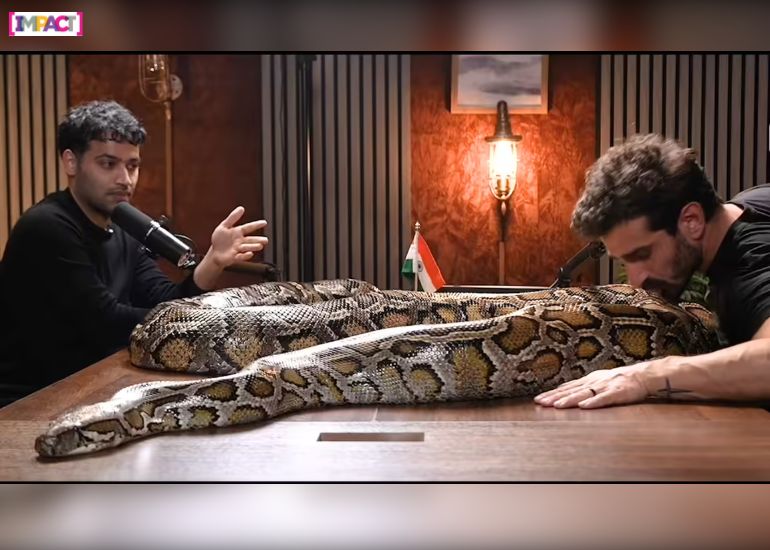
When Raj Shamani marked the 500th episode of ‘Figuring Out with Raj Shamani’ with American conservationist Paul Rosolie, the conversation extended far beyond the usual format. Rosolie brought a live Burmese python into the studio as part of a demonstration to explain snake behaviour and challenge common fears, turning the episode into a mix of education and spectacle. What could have remained a long-form, conversation-led episode turned into something far more visual, visceral, and designed to travel through various mediums. It became a moment engineered for attention.
Anadi Sah, NCD, Founding Partner & Chief Innovation Officer, tgthr sees this not as an isolated experiment, but as part of a larger evolution in how content itself is being designed. He says, “It signals a clear shift, transforming a traditionally audio-first podcast into a visual spectacle.” He explains that formats like these, tap into the multi-modal nature of today’s consumption. Sah also sees Shamani’s 500th episode as a strategic milestone in that sense, not just celebrating scale, but using it as an opportunity to reimagine the format itself.
“What Shamani did feels like a crazy hook to tighten the attention of his viewership. I mean, it does bring in fresh taste and perspective in a sea of podcasts following the traditional format,” says Mayank Gaba, Creative Director, SW Network. He clearly sees this as a deliberate hook. Content today works only if it either taps into widely discussed themes or builds a strong enough hook with a compelling storyline. Without that, audiences simply move on.
Vibhor Gulati, Founder, Defodio Digital highlights a deeper change in how content is discovered. “Long-form podcasts today aren’t competing over depth. They’re competing over discovery. And discovery is now clip-led. The clip travels further than the episode ever will,” he explains. The python, in that sense, becomes more than a visual prop. It becomes a distribution strategy. A moment that can be clipped, edited, amplified, shared, and consumed without context across platforms. Hence the journey from just conversations to hook feels ‘not accidental’.
However, this tactic is not entirely new. Globally, some of the most defining content moments have emerged not from what was said, but from what unfolded. When Elon Musk appeared on ‘The Joe Rogan Experience’ and smoked weed on air, the clip transcended the podcast itself. It entered mainstream discourse and shaped broader narratives. Similarly, formats like ‘Hot Ones’, the chat show hosted by Sean Evans have built entire identities around engineered reactions. Spicy wings act as triggers there, breaking media training and create instantly shareable moments.
Gulati points out that this is what audiences remember. Not the conversation, but that one moment. “Nobody recalls a 60-minute discussion, but everyone remembers the episode where a snake showed up,” he notes. The objective is clear then, memory is now tied to spectacle.
Rahul Tekwani, Founder & Managing Partner, Branding Edge sees the move as a way to widen the ‘entry point’ of the content. “A straightforward conversation wouldn’t really travel beyond his existing base,” he notes. The python changes that reality, pulling in even those with no prior intent to watch by giving them a reason to pause out of sheer curiosity. He adds that this doesn’t feel like something Shamani would have thought of in isolation, but is far more aligned with Rosolie’s world, with Shamani using it effectively to break through the clutter and extend reach beyond his core audience.
This blurring of conversation and experience is also visible in formats beyond podcasts. Shows like ‘Running Wild with Bear Grylls’ have long placed guests in physically demanding environments, turning interviews into immersive narratives. One of them was when Prime Minister Narendra Modi joined him. It was an unexpected crossover that blended entertainment, messaging, and national visibility in a highly unconventional format.
As creators continue to push formats in pursuit of attention, it also raises a more complex question around how brands might respond to such unpredictability.
Sah notes that while such content delivers strongly on visibility and engagement, brands will apply stricter filters around relevance and safety. Beyond perception, this includes physical safety, legal liability, and ethical considerations. The appetite to associate exists, but so does a higher threshold for alignment. He also notes that it sets a new benchmark, something other creators are likely to take cues from going forward. Hence, brands are expected to engage only where the association feels contextually and strategically aligned.
Gulati sharpens this divide. According to him, challenger brands, particularly in D2C, fintech, and youth-focused categories are more likely to embrace such high-virality moments. Legacy sectors like BFSI or pharma, however, are wired for predictability and control, making them more cautious. Gaba again, echoes the importance of fit, noting that forced collaborations can create immediate audience discomfort.
Taken together, this suggests that while brands are still calibrating their comfort with such formats, creators are already moving ahead, testing the edges of what works in an attention-driven ecosystem. Even in India, while most formats remain conversation-led, some creators are gradually introducing more visual or situational elements within their setups. Creators like Ranveer Allahbadia, for instance, have experimented with segments involving spiritual explorations or challenge-led interactions that move beyond static conversations. Similarly, Nikhil Kamath’s 'WTF is with Nikhil Kamath' often leans into unstructured, free-flowing discussions where the unpredictability of the exchange itself becomes the hook.
But how far can this go? What becomes the limit to these out-of-the-box experiments? If attention continues to reward spectacle, the threshold will inevitably rise. What feels bold today may become baseline tomorrow. Yet, the risk lies in excess where the pursuit of virality overshadows meaning.
For now, Shamani’s python episode sits at an inflection point, capturing a shift where podcasts are no longer just about what is said, but about what happens. And in an ecosystem where moments travel further than conversations, that distinction may define the future of content itself.