


Few companies have shaped the digital advertising landscape as profoundly as Meta. What began as Facebook: a platform built to connect friends has grown into an ecosystem that spans Facebook, Instagram and WhatsApp, serving billions of users and millions of advertisers worldwide.
Over the years, the company has steadily expanded its role in marketing. With its latest suite of AI-powered advertising tools, Meta is attempting another leap. The company's latest AI capabilities promise an end-to-end advertising workflow. Brands can now generate campaign creatives, produce multiple ad variations, identify suitable creators, automate media optimisation and measure campaign performance, all within Meta's own ecosystem. For marketers under pressure to deliver faster results with leaner teams and tighter budgets, the proposition is undeniably attractive.
But, the announcement raises a question that reaches far beyond technology. If one platform can now handle much of what agencies have traditionally planned and executed, how does the agency's role evolve? For Rashid Ahmed, Consulting CDO at Digital102, the latest announcement reflects a much bigger transformation than simply adding another AI feature. Meta, he believes, is no longer behaving like a conventional media platform. Instead, “It’s cross-integrating capabilities, behaving like a campaign operating system.” The upside is clear: faster campaign cycles, greater room for creative experimentation, sharper personalisation and less reliance on labour-intensive media workflows. For Indian brands managing diverse languages, markets, formats and creator ecosystems, these efficiencies can be especially valuable.
The appeal of that efficiency is difficult to ignore. Gaurav Sehgal, Vice President – Marketing at Medusa Beverages, acknowledges that Meta has become markedly more sophisticated over the years, with sharper targeting, stronger automation and tools like Advantage+ reducing much of the manual effort that once defined media buying. "I'm comfortable entrusting maybe 60 to 65 per cent of the execution layer to a platform like Meta, but the strategy, the brand narrative and the cultural context still need a human in the room," he says. For performance marketers, he notes, those efficiencies are meaningful. In categories like alcobev, he adds, brands are built around experiences, feelings and lifestyle associations. Something no platform can automate on its own. Execution is only one part of a much larger equation.
That distinction sits at the heart of the industry's response. While Meta promises convenience and speed, Sagar Nidavani, Founder and CEO of Clevertize, argues that marketers should ask a more fundamental question: "Who is the real benefactor here?" He believes Meta's growing role creates a potential conflict of interest, where the platform controls advertising inventory while also determining how campaigns are optimised and evaluated. "We would not put all our eggs in one basket. Our focus is on increasing experimentation while using Meta's capabilities to scale faster," he says, adding that while such an approach may work for businesses with limited resources, established brands should be cautious about becoming overly dependent on one ecosystem. In his view, the promise of convenience should not come at the cost of independent strategic thinking or broader market perspective.
Gaurav Verma, Chief Business Officer, PharmEasy echoes the caution, but from a different perspective. The company is comfortable relying on Meta for the heavy lifting around bidding, placements, audience expansion and creative combinations. Automation tools like Advantage+, he adds, “take real grunt work off the table. It finds demand we would otherwise miss and lets us iterate on creatives much faster.”
But he highlights measurement cannot sit with the same platform that sells the media. "We are not comfortable letting the same platform optimise the spend, bill us, and then grade its own performance." Instead, campaign effectiveness is validated through backend data, mobile measurement partners and incrementality testing, particularly in healthcare, where attribution patterns can change without actual demand shifting.
The concern, then, is not whether Meta's AI can improve efficiency—it clearly can. The bigger question is whether efficiency alone can build enduring brands. Ahmed believes marketers should treat Meta's AI as "an acceleration layer, not as the marketing brain." While the platform can automate execution and improve performance, he argues that brand-building demands something more enduring. "The platform can tell a brand what is performing. It cannot always tell the brand what it should stand for," he says. Metrics may reveal what works in the moment, but they cannot independently define a brand's cultural role, category point of view or long-term memory structure.
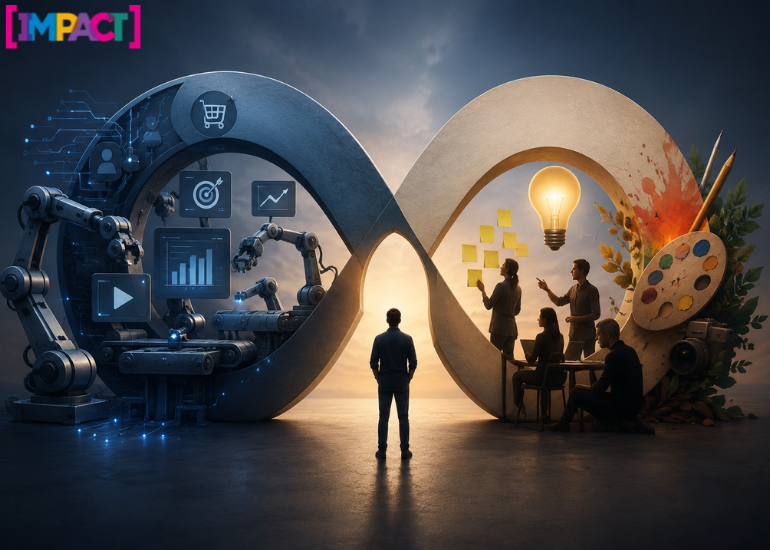
It is this distinction that turns Meta's latest AI push into something far bigger than a product update. The debate is no longer about whether artificial intelligence can generate ads or optimise campaigns. Those capabilities are already here. But, the changing equation is already reshaping what brands expect from their agency partners. Verma says, “The button-pushing is going away, and that’s fine. If an agency’s pitch is ‘we will run your Meta account and send you a report,’ the platform now does that itself, cheaper and faster.” What, then, remains the competitive advantage for agencies?
At Liberty Shoes, automation has taken over much of the operational work, allowing agencies to focus on areas where human judgment matters most. "We're comfortable letting the machine own automation. What we hold agencies accountable for is what technology has no opinion on: a brand idea rooted in who Liberty is, cultural fluency across the different consumers we serve through Healers, Leap7X and Lucy & Luke, Aha and the judgement to choose the right creative direction rather than simply the best-performing one," says Anupam Bansal, Executive Director at Liberty Shoes. For him, agencies are no longer being measured by how efficiently they manage campaigns, but by how effectively they shape the brand itself.
This is an area where Ahmed, precisely, believes agencies must evolve. He argues that agencies have to move higher up the value chain, strengthening their role in strategy, brand thinking, creative intelligence, cultural decoding and cross-platform accountability. Consumers do not live only inside Meta, he points out, they move across Instagram, YouTube, marketplaces, OTT platforms, offline retail and everyday conversations. Connecting those touchpoints into one coherent brand and business strategy is a role platforms alone cannot fulfil. The future agency, he says, will need to know how to prompt, audit, interpret and challenge platform AI—not simply operate dashboards.
For instance, Sehgal highlights Medusa's ‘House of the Dragon Fire Edition’ campaign. He notes that no algorithm decided how the campaign should come together. That required people who understood the brand, the consumer and the cultural moment.
Nidavani, however, sees the transition as an opportunity rather than a threat. For years, agencies have struggled to bridge creative thinking with performance marketing at scale. AI, he believes, can remove much of the repetitive work that kept those functions apart. "Meta is replacing the mundane jobs, not the original thinking," he says.
As routine execution becomes automated, creative teams can spend more time understanding cultural and behavioural nuances, while performance specialists can focus on connecting business outcomes with creative insights instead of merely reporting campaign metrics.
Meta's latest AI push may not diminish the importance of agencies overnight, but it does redefine what clients are likely to value. With platforms continuing to absorb the mechanics of advertising, agencies will increasingly be judged not by how efficiently they execute campaigns, but by how clearly they define brands, challenge assumptions and connect technology with human insight. It is, as Verma puts it, "the story and the judgment a black box can't replace."