


People have stopped paying attention to ads. They’re paying attention to their chats. And that, in a sentence, is why brands are suddenly very interested in conversational advertising—showing up not on feeds or search pages, but inside the DMs, group chats, and messaging apps where people actually spend their time.
Snapchat and Kantar’s latest research has put data behind what marketers have been sensing for a while: younger audiences are moving away from public feeds towards private, conversational spaces, and they’re making real purchasing decisions there. For brands built around broadcasting, that’s both an opportunity and a problem.
From feeds to conversations “The younger audiences, especially Gen Z, today are increasingly spending time in more private, close-knit digital spaces, and that is naturally changing how they engage with brands as well,” says Yagnesh Ravi, Lead – Ad Solutions at Snap Inc. “What we are observing, including our recent research with Kantar, is that conversations among friends carry a stronger sense of trust, attention, and intent compared to traditional passive scrolling environments. On Snapchat, chat is not just a messaging utility; it is where people share recommendations, discuss products, and discover what matters to them in real time. For brands, the opportunity is not just about being present where they are the most engaged, but about being culturally resonant within conversations.”
Snapchat’s research from India found that 93 per cent of Snapchatters said Sponsored Snaps fit naturally into their platform experience, while 95 per cent found the ads relevant to them.
The chat commerce boom
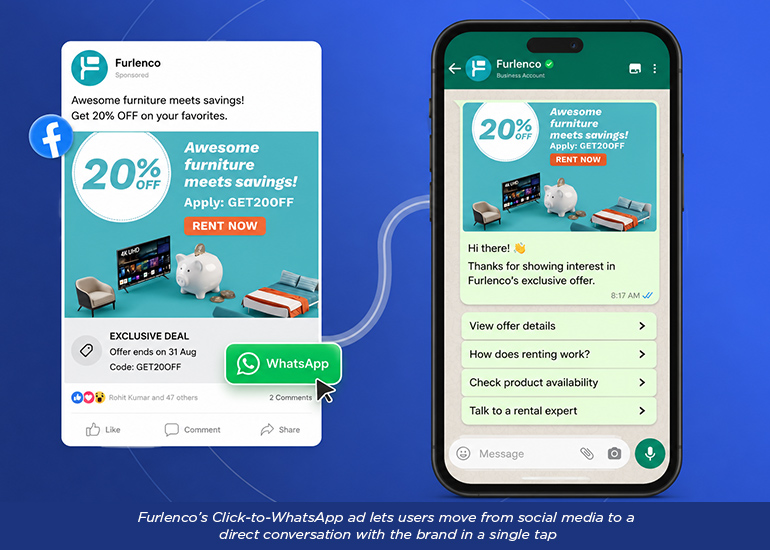
Nowhere is this shift more pronounced than in India, and nowhere are the stakes higher. WhatsApp has roughly 535–536 million monthly active users in the country, projected to cross one billion by the end of 2026. The platform grew 314 per cent between 2021 and 2025 in India alone—and the commerce numbers are catching up with the usage numbers fast.
Retailers adopting WhatsApp-led commerce strategies reported a 61 per cent average improvement in return on ad spend and a 62 per cent increase in lead generation, according to a retail whitepaper jointly released by Meta and the Retailers Association of India. Insurance is a category where trust matters more than almost anything else, as people are cautious, the decisions are considered and the drop-off points are many. This makes Policybazaar’s experience with WhatsApp worth paying attention to. “At Policybazaar, WhatsApp is a meaningful part of the full customer lifecycle: policy reminders, renewal nudges, document collection, claim support, and first-touch re-engagement for lapsed/dormant users,” says Shubham Choudhary, BU Head - Growth at Policybazaar.com. “A renewal reminder on WhatsApp gets opened; the same message on any other channel often doesn’t.”

The math that makes conversation unavoidable Kshitij Kulkarni, a Marketing and Revenue Strategist, makes a straightforward case: paid platforms like Meta and Google are good at bringing in new customers, but expensive for keeping them. “You can’t run retention on a channel that charges you to talk to your own customer,” he says.
He adds, “A WhatsApp message to a buyer who already knows you costs almost nothing. A win-back nudge, a category recommendation, a reorder flow for the customer who bought your coffee six weeks ago—that’s where lifetime value is actually built.”
Kulkarni further adds, “The brands getting this right are running reorder flows, win-back sequences, category upsells, and loyalty offers through WhatsApp the same way they once ran email—except open rates are an order of higher magnitude and payments are built in.” Angela Toppo, CMO and Co-founder of Be Wellness, believes the shift is being driven as much by economics as by consumer behaviour. “India’s D2C brands are facing rising customer acquisition costs across Meta and Google, which is forcing them to invest in owned channels. Conversational messaging is no longer an experiment; it’s becoming the new retention infrastructure. On platforms like WhatsApp, consumers don’t just receive offers, they ask questions, seek advice and build trust with a brand. When people feel heard rather than marketed to, they’re far more likely to return.”
The thin line between engagement and intrusion
The intimacy of chat cuts both ways. Enter someone’s WhatsApp without something worth saying, and you don’t just lose a click, you lose the relationship. Several marketers are emphatic that most brands are already getting this wrong. “Most brands are making the mistake of treating WhatsApp like email marketing with blue ticks,” says Gayatri Sethi Jain, Founder of CtrlA India. “That approach is going to fail very quickly. Private messaging is personal territory. If a brand enters that space without relevance or restraint, consumers will shut the door instantly. The brands that win will be the ones that respect attention instead of constantly demanding it.”
 Tanvi Bosmia, Vice President - Business at SoCheers, agrees that the problem isn’t technology, it’s discipline. “The line between useful and intrusive is incredibly thin in private messaging spaces, and many brands cross it because they’re chasing short-term metrics. Open rates and clicks can look great right before a consumer mutes or blocks you.”
Choudhary is candid about the failure mode he’s seen and sometimes fallen into. “Most brands are already getting it wrong, continuously using a strategy that can only be called spray and pray.” His framework at Policybazaar is built on three principles: relevance over volume, channel fit, and genuine consent and control. “The brands that win long-term and maintain sustainable engagement rates are the ones that give users genuine preference control.”
Kulkarni points to timing as the real culprit behind most intrusive experiences. “A buyer looks at a product on a website, and ninety seconds later, a WhatsApp flow pings them about that exact product. That’s not personalisation; that’s surveillance with a discount code.”
Beyond the feed
Jain frames the broader cultural shift at play. She mentions, “Public social media today is a crowded theatre. Everyone is performing, shouting, and chasing trends. But real consumer decisions are increasingly happening in private. Conversational platforms force brands to communicate like humans, not billboards. The future of marketing is less about visibility and more about credibility.”
The brands winning in this space aren’t treating conversational as an add-on. They’re building their entire retention architecture around it.
“Most brands still underestimate how big this shift is,” says Bosmia. “If used well, the entire customer journey can live there—from discovery to purchase to support to re-engagement. If not used effectively, it just becomes another place consumers learn to ignore you.”
Every major shift in digital advertising has followed the same pattern: brands find where people are, flood in, and eventually wear out their welcome. Chat-based advertising doesn’t have to follow that script. But that will depend entirely on whether brands treat it as a relationship or just another funnel.