

You look up a handbag once; maybe pause for a few seconds on a sneaker Reel, or even mention a holiday to a friend, and suddenly, your Instagram, YouTube, OTT apps, and shopping feeds begin speaking the same language. Does it not feel oddly convenient? Today, the Internet seems to understand what you want. It helps you with your mood, guides you through your wishes and understands the language of your heart. But between the fifth identical ad and the tenth repeated video, relevance starts feeling less like personalisation and more like surveillance.
According to Criteo’s recent report, ‘From Fragmented Touchpoints to Connected Journeys: A New Commerce Playbook for India’, developed in collaboration with Ecosystm, more than 60 per cent of Indian consumers find history-based ads helpful. 84 per cent said they would prefer fewer and more relevant ads, while 71 per cent admitted they continue seeing repetitive messaging across platforms. The report also noted that consumers are no longer making purchase decisions within one ecosystem. Nearly 44 per cent engage across multiple channels before making a purchase, while 51 per cent research products outside retail platforms before buying.
For the advertising world, this calls for a difficult balancing act. The same digital ecosystem that allows brands to target consumers with precision is also increasing the risk of overexposure. And the problem is no longer limited to frequency alone. Consumers are not simply complaining about seeing too many ads; they are reacting to seeing the same message everywhere, often without context, platform sensitivity, or variation. “With approximately three trillion ad impressions being served in a quarter in India, the clutter in ads space is already too high,” said Anmol Dang, VP Media - West, Kinnect. The concern is not frequency alone, he added, but where that frequency is coming from. A consumer seeing the same ad across multiple touchpoints may still help reinforce recall. The problem begins when exposure becomes concentrated on a single platform, making campaigns feel repetitive rather than memorable.
“One message needs to be served to a user at least three to four times for that message to sink in,” Dang said. “But this frequency has to be delivered cumulatively, as a summation of multiple touchpoints and not just a single one.” Dang called this cumulative exposure the ‘thumb rule of the thumb rule,’ arguing that repetition works best when spread across ecosystems rather than concentrated within one platform.

The problem has become more visible as media habits continue fragmenting. A consumer could watch a cricket clip on Instagram, continue the match on CTV, browse products on an e-commerce platform, and end the day on YouTube Shorts, all while seeing versions of the same campaign. And in many cases, frequency is still being controlled platform by platform, leading to overlapping exposure across ecosystems. For Sonam Pradhan, Head - Media & Digital Marketing, South Asia, Kellanova, the fragmentation of consumer journeys has fundamentally changed how brands need to think about media planning. Consumers today move seamlessly between Connected TV, OTT, social media, retail media, and mobile ecosystems, often within the same purchase journey. According to Pradhan, managing exposure within isolated platform silos no longer works because consumers themselves are no longer behaving in silos. “The focus today is on maximising weekly unique reach rather than over-serving the same audience repeatedly across platforms,” Pradhan noted.
 This, according to Neha Singh, Branch Head, Enormous Mumbai, is also exposing a larger creative and long-standing issue within the advertising ecosystem. “The honest truth is that a large part of the industry is still taking a master creative and resizing it for different platforms,” Singh pointed out. “That’s not personalisation, that’s photocopying.”
As brands push for visibility across screens, platform adaptation often gets reduced to formatting changes instead of contextual communication. The way consumers engage with a six-second YouTube bumper is vastly different from how they passively consume Connected TV or scroll through Instagram Reels, yet many campaigns continue carrying identical messaging everywhere.
“At Enormous, we draw a hard line between what stays fixed and what flexes,” said Singh. While the core campaign thought remains unchanged, its expression needs to evolve depending on audience mindset, platform behaviour, and consumer demands.

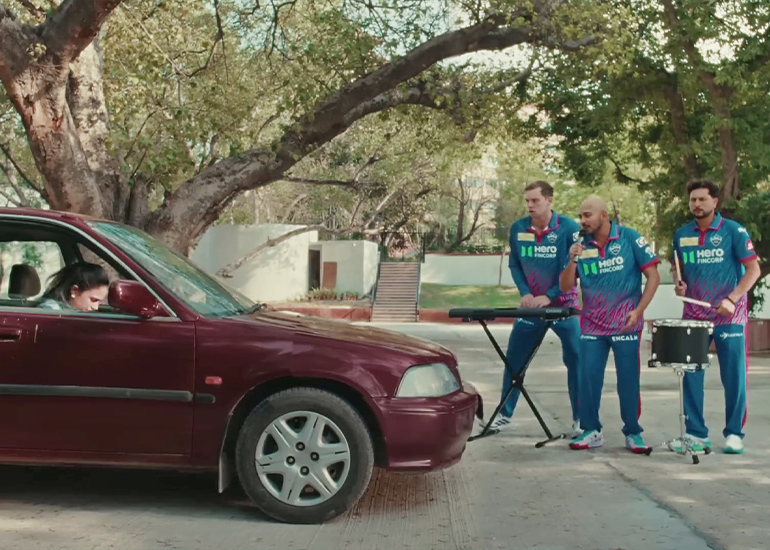
She pointed to Hero FinCorp’s ‘AI Ki Aasani’ campaign as an example. While the central brand thought remained intact, the messaging evolved depending on the audience segment being addressed. “The two-wheeler customer heard something different from the home loan customer. Same brand truth, different human entry point,” Singh explained.
And the stark distinction has become increasingly important because consumers are interacting with advertising almost continuously throughout the day across platforms. Binit Kumar, AGM Marketing, Dabur India, believes this is relevant in mass FMCG categories where consumers are not deeply invested in brand relationships to begin with. “We’re cautious about micro-personalisation for mass FMCG,” Kumar said. “Growth comes from light and lapsed buyers who think about toothpaste for ninety seconds a month.”
Instead of aggressively pursuing one-to-one personalisation, Dabur has been focusing more on contextual relevance. According to Kumar, consumers in categories like oral care are not looking for constant interaction with brands. What matters more is recall and relevance during moments of consideration. “They don’t want a personal relationship with us,” he said. “They want us to be easy to recall and easy to find.”
That has led the company to build communication around category triggers and everyday consumer situations rather than isolated targeting buckets. Kumar explained that the brand’s communication ecosystem is designed around moments when consumers naturally begin to think about oral care—whether it is discomfort, social anxiety, visible staining, or other behavioural triggers.
Dabur has made an ecosystem and a playbook where not all posts look identical, but every story belongs to the same narrative. Campaigns like ‘Chabate Raho’, built around food and sports rivalry, and ‘Desh Ka Laal’, a podcast series centred on the armed forces, are designed to widen storytelling while staying rooted in the same brand world.
But even if brands recognise the problem, how exactly can they reduce fatigue without losing visibility? The answer lies in creative variation and sequencing rather than simple repetition.

 “There is a stronger focus on frequency governance, creative rotation, and shorter refresh cycles to avoid fatigue,” said Soumali Chakraborty, Head of Marketing, Arrow Menswear. She believes the issue goes beyond simply reducing the number of ads consumers see. Brands are increasingly moving towards intent-led communication, where messaging changes depending on consumer behaviour and the stage of their journey rather than repeating the same creative everywhere.
Dang, meanwhile, highlighted Dynamic Creative Optimisation (DCO) as one of the tools helping brands manage exposure across platforms. Calling it an old but still underutilised concept, he said DCO allows campaigns to personalise messaging dynamically instead of repeatedly serving one static creative.
Kumar also pointed to sequencing as an emerging approach to reduce repetitive exposure. He said that Dabur recently experimented with sequencing multiple creatives within a VVC campaign based on audience engagement behaviour, thus helping improve VTR while lowering CPV.
Creative fatigue, however, is not always immediately visible. In many cases, campaigns continue delivering impressions while audiences gradually disengage. “There is no one North Star metric,” Dang explained. “It’s a combination of at least a couple of metrics.” For performance campaigns, rising CPMs alone may not indicate fatigue if conversions remain healthy. In video-led campaigns, however, plateauing reach and falling VTRs often become stronger indicators of consumers are tuning out.
Alongside media and creative changes, organisational structures are also evolving quietly in the background.
At Kellanova, Pradhan said media, analytics, ecommerce, and creative teams are increasingly operating together rather than functioning independently around separate KPIs. Similarly, Kumar noted that Dabur’s brand, media, digital, and ecommerce teams now work through shared campaign calendars and unified consumer journey maps. Chakraborty added that closer coordination between media, creative, analytics, and CRM teams is becoming essential to reduce overlaps in messaging and create more connected consumer experiences.
The larger industry conversation, however, is no longer just about efficiency or targeting precision. It is about consumer attention itself. As platforms continue to evolve and consumer behaviour becomes harder to predict, marketers say there is no fixed formula for attention anymore. But across the industry, one thing is becoming clearer in a crowded digital ecosystem, relevance may matter far more than relentless visibility.